

Shared experiences are scarce now
How the World Cup demonstrated why moments of collective participation carry greater cultural value than ever before.

This post is part of our Guest writer series, EXTENDED THINKING, where we invite the most compelling writers, strategists and thinkers out there to give us their best takes on culture. This week, we are having an essay by Manchester-based writer Meg Parrott.
I started writing this on the afternoon of the World Cup quarter finals, after spending the morning in the barber’s chair at my local in south Manchester.
As I waited, my attention drifted towards Will, the owner, dressed in a retro England shirt and debating the team’s starting eleven with a man getting a short back and sides.
Tonight, my mates are projecting the game onto the side of their house in Old Trafford. The message in the group chat read: “Like this if you’re coming so we know we have enough chairs.”
Adam later admitted he’d sent it to three more WhatsApp groups. The neighbours were invited too.
Culturally, the 2026 World Cup has been difficult to ignore. Everywhere you looked, there were reminders. The middle aisle of Lidl, office sweepstakes and the cars parked along my street were all marked with the St George’s Cross.
My Instagram, naturally, was no different.
 Tiktok failed to load.
Enable 3rd party cookies or use another browser
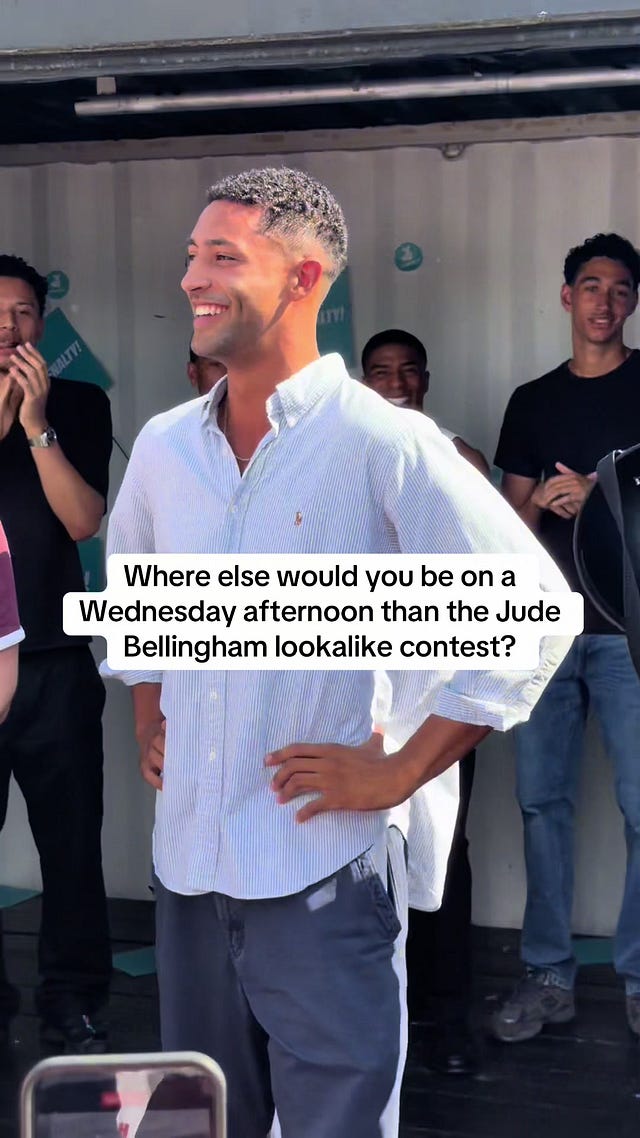
The algorithm served me Bug, the score predicting Brussels Griffon, the Jude Bellingham lookalike competition in Shoreditch, and Paul “Tango” Gregory, England’s viral superfan, who reportedly spent £5,000 following the team through the tournament. Pot bellied, tattooed with Three Lions and rarely seen without a Stella in one hand and a gold chain around his neck, he became an unlikely symbol of England’s travelling support.
For all the memes, packed pub gardens and public screenings, the tournament’s cultural scale has been remarkable. The World Cup is expected to have contributed £7.6 billion to the UK economy while generating more than 20 billion views across FIFA’s social media platforms. Arguably, it has never occupied quite so much cultural attention.
Yet the tournament also embodies a contradiction. Our affection for the World Cup increasingly exists alongside our distrust of the institution that stages it. Loving football at this level no longer requires believing that it sits above politics or commercial interests. If anything, every tournament seems to offer fresh evidence of the opposite.
Every four years, the list grows longer.
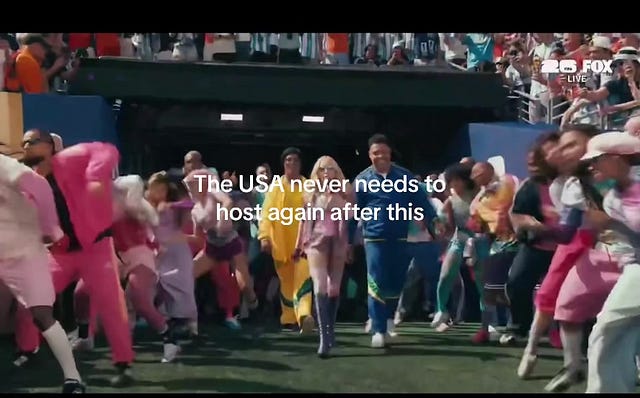
This year, FIFA introduced a Super Bowl style half time show for the final, prompting criticism that football’s biggest occasion was becoming another entertainment spectacle.
 Tiktok failed to load.
Enable 3rd party cookies or use another browser
In case you missed it, imagine Ronaldinho, Ronaldo and Madonna arriving together in a gold car.
The emotion of national anthems was interrupted by compulsory hydration breaks accompanied by advertising, reportedly generating more than $250 million in the United States alone. Matches increasingly resembled carefully choreographed productions rather than sporting contests. For the quarter final, spectators paid from $2,049 for the privilege.
Accusations of corruption surrounded Argentina and claims of biased refereeing, while some fans questioned whether the United States should ever host another World Cup.
Five players facing a combined twelve rape allegations were permitted to compete without suspension.
The tournament’s estimated carbon footprint reached 7.8 million metric tonnes of CO₂, more than double the official emissions reported for Qatar 2022.
Despite holding an official appointment and a valid visa, Somali referee Omar Abdulkadir Artan was denied entry to the United States. Fans from countries affected by partial or full travel bans, including Haiti, Iran and Senegal, were also unable to attend.
None of these stories felt exceptional. Scandal has become part of the World Cup itself, expected rather than disruptive.
What has changed is our ability to separate the game from the institution behind it. We criticise FIFA in one breath and clear our calendars for kick off in the next.
Perhaps that is because the World Cup now performs a role that extends well beyond football. It is no longer simply a celebration of the sport at its highest level. It has become one of the few remaining moments capable of bringing large numbers of people into the same cultural experience.
For all our constant connectivity, we increasingly consume culture alone. Netflix recommends something different to each household. TikTok delivers a unique feed to every user. Spotify builds playlists designed specifically for us.
We may all be watching Love Island, but we are watching it separately, in our own living rooms or on headphones during the commute.
Shared cultural experiences have become increasingly rare.
The World Cup briefly interrupts that pattern. For ninety minutes, despite all its flaws, it becomes one of the few remaining forms of genuine mass culture.
When third spaces, particularly free ones, are increasingly difficult to find, living rooms become gathering places and gardens become cinemas.
Yes, the World Cup dominates our feeds. But its significance has never really been created by content. It comes from proximity. From finally speaking to the neighbour you’ve only ever acknowledged while putting the bins out. From the temporary feeling that everyone is participating in the same story.
Perhaps that is why these moments feel so valuable today.
Sociologist Émile Durkheim described this as “collective effervescence”: the feeling of belonging that emerges when people experience something together. More than a century later, watching England may be one of its clearest modern expressions.
More than three million adults in England experience loneliness, while average daily screen time has reached around seven hours. Trust in football’s governing bodies may have declined, but our need for the rituals surrounding the game appears only to have grown.
Those rituals also carry cultural meaning beyond football itself.
England’s current squad is among the most ethnically diverse the country has ever fielded. Twenty of the twenty six players have overseas heritage. The manager is German.
This is not simply a football team. It is a portrait of contemporary England.
Whatever version of patriotism today’s political discourse seeks to define, the World Cup reflects the country as it actually exists. Multicultural, interconnected and continually evolving.
If culture reflects people, then the World Cup remains one of its clearest mirrors. Different family histories, different faiths and different races, all wearing the same shirt.
Nor is England unique. For a few weeks, nations stopped feeling like abstractions and began feeling human. Norway’s viral Viking Row chant carried a distinctly Nordic identity across the Atlantic.
Scotland’s Tartan Army reminded the world that football has always been as much about the people in the stands as those on the pitch.
These moments are acts of cultural exchange as much as sporting tradition.
Strip away the sponsorships and the politics, and what remains is remarkably simple. People finding reasons to come together.
The World Cup may monetise football, but its culture is created elsewhere. In flags attached to car windows. In neighbours invited into gardens. In conversations about last night’s result while waiting in the corner shop.
The opportunity now is not simply to watch football, but to recreate more of the conditions that surround it. Playing locally. Joining a casual kickabout. Leaving the phone at home. Bringing an old friend. Meeting a new one.
It was just after 1am when I cycled home after the quarter final. Through open windows came the sound of celebrations I could not see. Just before I reached home, I turned my usual corner and found a group of friends celebrating in the street after stopping an Uber, the driver joining in with them.
England did not win the 2026 World Cup. But I cannot think of another cultural moment that would have persuaded me to carry my own chair down the road simply to sit with neighbours and watch together.
Whether you care about football or not, perhaps that is what matters most. Not the tournament itself, but the reminder that people are still looking for reasons to leave the house, share an experience and speak to one another.
It is the Beautiful Game, after all.
Really enjoyed this take - I wrote about the World Cup a few weeks ago, whilst collective participation is happening, I do think the younger generation are experiencing the World Cup in a much more fragmented way online. I don't think they will/are inheriting the pub culture, the bbqs or the neighbourhood screenings.
https://fieldnotesofacreativedirector.substack.com/p/the-world-cup-exposes-what-big-brands
Bad news and division fuel ad spending and subscriptions. Feckless leaders divide and conquer, The World Cup was the greatest demonstration of the opposite, of what scientists call -- unity, that feeling of togetherness and shared identity with people who are not just similar to us, they are of us.